Courses and Theses
Below you find an overview of currently available Bachelor and Master theses and courses taught by the chair of Ecosystem Management. For more information on the courses please check the Course Catalogue.
Open Bachelor and Master theses
Supervisor and contact: Dötterl Sebastian; Co-supervisor: Florian Knaus, UNESCO Biosphäre Entlebuch
Böden sind die grössten Speicher von Kohlenstoff auf der Erde. Im Zuge der Anstrengungen nach Netto-Null sollen alle Potentiale, speziell auch diejenigen in der Landwirtschaft ausgeschöpft werden. Im Entlebuch, einer stark landwirtschaftlich geprägten Region der Voralpen (Kanton LU) ist die Landnutzung generell sehr intensiv und praktisch alles ist Grasland. Für dieses landwirtschaftliche System sollen zwei Kernfragen beantwortet werden: 1) Wie ist der Kohlenstoffgehalt in verschiedenen Böden (geographisch verteilt und auch verteilt nach Landnutzungsintensität)?Diese Frage soll mit Feld- und Laborarbeit beantwortet werden. 2) Mit welchen Anpassungen in der Landnutzung könnte in den verschiedenen «Boden- oder Landnutzungstypen» mehr C eingelagert werden? Diese Frage wird experimentell oder theoretisch beantwortet.
Die Vornutzung, also eine Schnittnutzung oder Beweidung im Frühling, wird aktuell im Rahmen von Naturschutzmassnahmen in einem grösseren Projekt in der Schweiz getestet. Die Vornutzung verändert die Struktur der Vegetationsdecke und das Mikroklima im Pflanzenbestand, was für eine günstige Entwicklung von Eiern und Raupen von Tagfaltern entscheidend sein. Doch verschiedene Arten haben unterschiedliche Bedürfnisse an den Lebensraum und reagieren entsprechend anders auf neue Bewirtschaftungsformen. In der Arbeit sollen folgende Forschungsfragen angegangen werden:
- Welche Insektenarten (insbesondere Tagfalter) bevorzugen die Flächen mit Vornutzung zur Eiablage, welche Arten meiden sie eher?
- Lassen sich innerhalb der neun Untersuchungsgebiete gemeinsame Muster erkennen?
- Stimmen bei oligophagen Arten Flugzeit und Phänologie der Nahrungspflanze überhaupt noch überein?
Die Arbeit wird zusammen mit Stefan Birrer vom Ökobüro Hintermann Weber betreut. Weitere Informationen bei Florian Knaus ().
Werden Pflanzen durch die Vornutzung, also einer Schnittnutzung oder Beweidung im Frühling, in ihrer Entwicklung zurückgeworfen, kann dies einen verzögerten Blühzeitpunkt zur Folge haben. Bisherige Untersuchungen zeigen, dass die Auswirkungen auf die Blühphänologie komplex sind: ein Teil der Arten blüht verstärkt, andere Arten werden in ihrer Blühaktivität negativ beeinflusst. Blüten bieten vielen Insekten Nahrung, weshalb die phänologischen Auswirkungen der Vornutzung relevant für das ganze Ökosystem sind. Das Blütenangebot einer Wiese über die Zeit ist für ein entscheidender Faktor für die Fitness vieler Arten. In dieser Arbeit sollen folgende Fragen beantwortet werden:
- Wie sind die Veränderungen des Blütenangebots für die Bestäuberinsekten insgesamt zu beurteilen?
- Welche Gruppen von Bestäuberinsekten profitieren, welche werden benachteiligt, unter Einbezug der gesamten Vegetationsperiode
Die Arbeit wird zusammen mit Stefan Birrer vom Ökobüro Hintermann Weber betreut. Weitere Informationen bei Florian Knaus ().
Durch die Vornutzung, also einer Schnittnutzung oder Beweidung im Frühling, ist die oberirdische Biomasse zumindest zeitweise deutlich verringert. Sonneneinstrahlung und Lufttemperaturen in Bodennähe sind erhöht. Es ist denkbar, dass sich dies auf die Aktivität, die Bestandesgrösse oder gar die Artenvielfalt von Insekten und Spinnen auswirkt, die sich bevorzugt in Bodennähe einer Wiese oder Weide aufhalten. Zumindest ein Teil dieser Arten könnte durch eine Vornutzung begünstigt werden, aber auch eine Reduktion von Populationsgrössen oder der Artenvielfalt sind denkbar. Im Fokus dieser Arbeit stehen biotoptypische Arten der Trockenwiesen und Flachmoore. Je nach Kenntnissen des/der Studierenden kann die Arbeit auf einfach zu erfassende Arten (z.B. Feldgrille, Wulstige Kornschnecke) oder aufwändigere Gruppen (Laufkäfer, bodenjagende Spinnen) beschränkt werden.
Die Arbeit wird zusammen mit Stefan Birrer vom Ökobüro Hintermann Weber betreut. Weitere Informationen bei Florian Knaus ().
Bachelor Courses
Course coordinator: Jaboury Ghazoul and L. Bialic-Murphy; course 701-0371-00L
Conservation and restoration are interdisciplinary sciences that nonetheless are founded on fundamental ecological concepts. The course will explore theoretical underpinnings of conservation and restoration science that inform planning and implementation, and consequent outcomes. New concepts and emerging technologies will be explored, alongside case studies that inform discussions.
Course coordinator: Jaboury Ghazoul, Anne Giger Dray; course 701-0324-00L
Tropical rain forests, the world's most biodiverse habits, suffer from habitat loss, fragmentation, and climate change. Their continued degradation will impact future climate, global biodiversity, and livelihoods of billions of people. We will explore the structure, dynamics, and ecological functions of rain forests to provide the scientific foundation for their conservation and restoration.
Course coordinator: Florian Knaus; course 701-0310-00L
In this course, the students explore the theoretical foundations, conceptual models and practical implementations of conservation activities both in Switzerland and internationally. Based on case studies, they are introduced to different views, values and ideals inherent in these activities.
Course coordinator: Jaboury Ghazoul and Adelaide Sanders; course 701-0034-21L
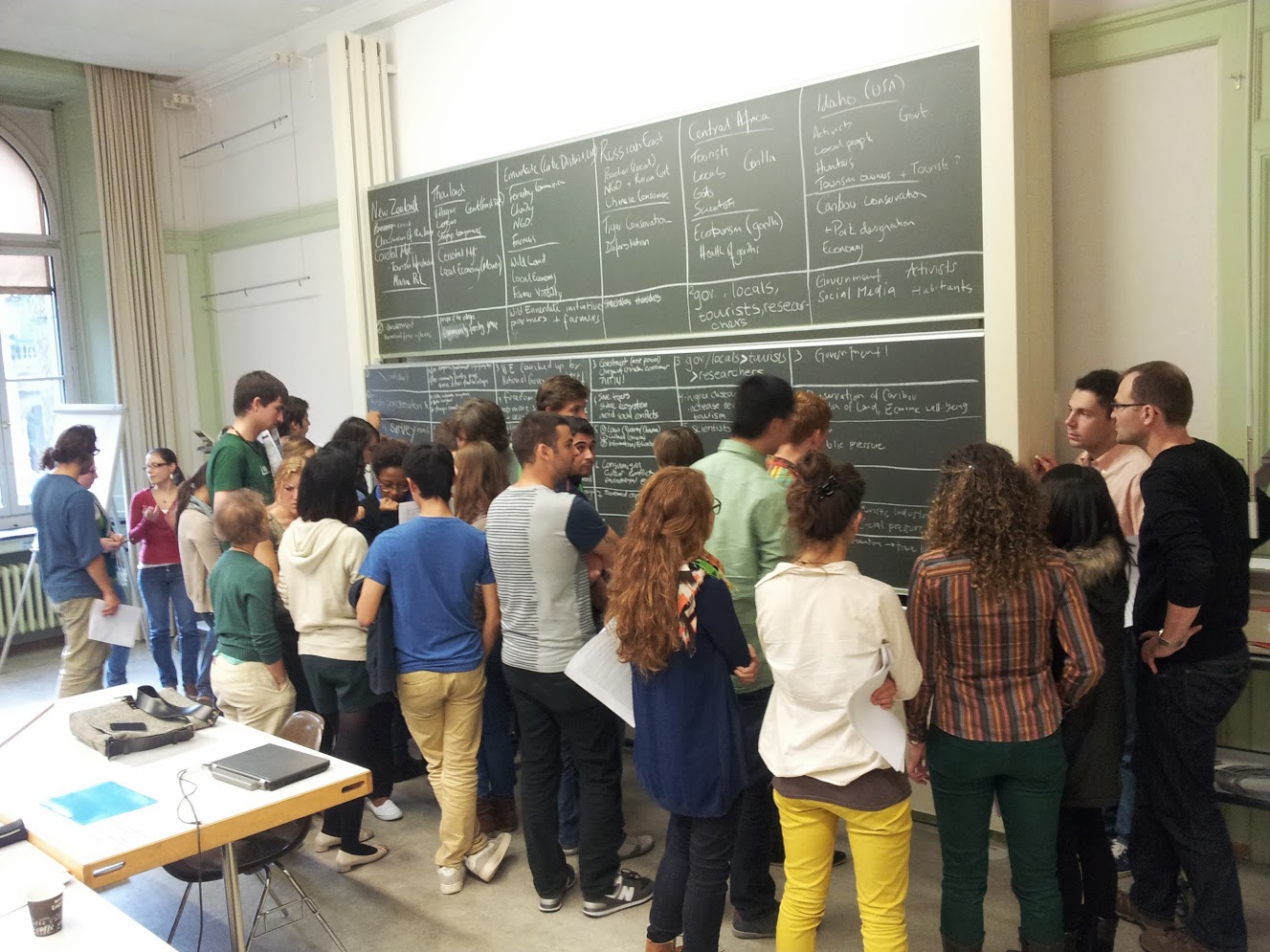
This first-year Bachelor course allows students in small groups to develop their own research question, design and carry out data collection in the field and finally analyse and contextualise their results.
Course coordinator: Giacomo Vaccario, Anne Drayand Maaike Goedkoop; course 701-0034-24 P
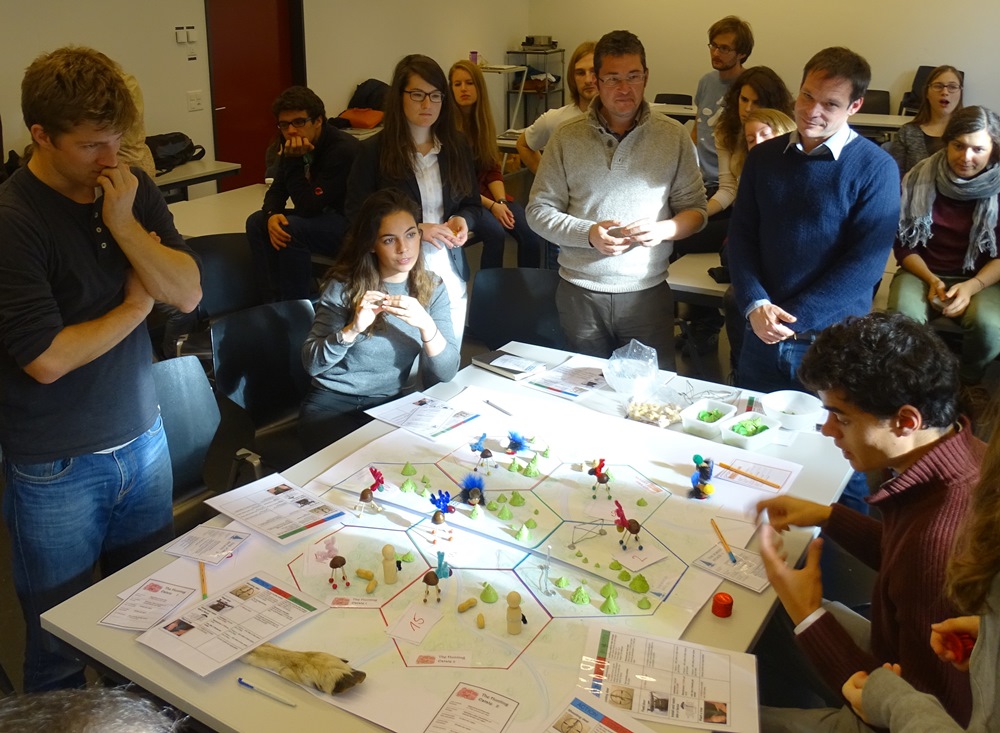
The course focuses on developing system dynamic models for socio-technical transitions. With the practical case of upscaling the use of wood for construction, students will interact with stakeholders of the wood supply chain and model 1) their relations, 2) emerging non-linear dynamics (e.g., feedbacks and tipping points), and 3) trade-offs between economic, societal, and environmental benefits.
Master Courses
Course coordinator: Jaboury Ghazoul; course 701-0019-00L
The rise of the environmental sciences, and theincreasing importance of the environment in society and governance, has beendramatic and rapid. Issues in the environmental sciences are now so broad andimportant that they reach into all aspects of society, from food and land use, to water management, energy use, economics, culture and health. With suchbreadth it is easy to lose sight of the foundational ideas, texts, people and movements that pushed the environment up the social and political agenda. The course provides students with opportunities to read, discuss, evaluate and interpret key texts that have shaped the environmental movement and, more specifically, the environmental sciences.
Course coordinator: Florian Knaus; course 701-1453-00L
The course provides methods and tools for ecological evaluations in nature conservation and landscape planning. It deals with census methods, sampling designs, ecological indices and criteria evaluating ecological data. Objectivty and accuracy of vailable methods and tools are critically appraised. Birds and plants are used as main example guiding through different case studies.
Course coordinator: Jaboury Ghazoul and Anne Giger Dray; course 701-1631-00L
Failure of traditional management has stimulated ecosystem management approaches that emphasise functionality of human-dominated systems, ecological processes and services, diverse spatial and temporal scales, and multiple stakeholder interests. This course explores ecosystem approaches to management and asks: is it realistic, how can it be achieved, and what are the barriers to its uptake?
Course coordinator: Florian Knaus; course 701-1456-00L
This course introduces students to an unfamiliar socio-ecological system that combines high depopulation rates and corruption with extraordinary cultural and biological diversity under high threat of loss. This system is explored with local stakeholders and in the field, analysed and measures identified that support both conservation and development goals.
Course coordinator: Jaboury Ghazoul; course 701-1446-00L
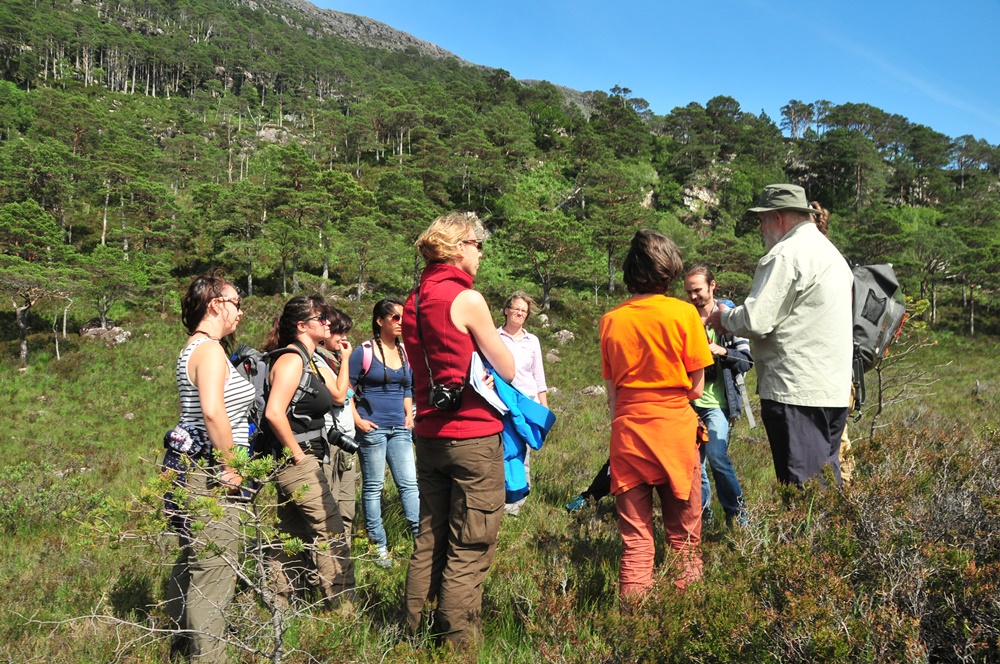
This course will explore how conservation and restoration is being implemented in the Highlands of Scotland, what conflicts across landscape and resources arise, and how such conflicts might be resolved. By visiting projects and locations, and by interviewing experts and practitioners, students will evaluate how restoration goals might be implemented across a range of social and environmental priorities. For more impressions there are two videos below.